Renting a Flat in Sheung Wan Between Central Convenience and Dried Goods
A frank look at renting in Sheung Wan, weighing the short walk to Central against the pervasive dried seafood aroma on certain streets and the actual flat prices.
Renting a Flat in Sheung Wan Between Central Convenience and Dried Goods
The smell hits you first. On Des Voeux Road West, between Wing Sing Street and Hillier Street, the air carries dried abalone, scallop and ginseng from two hundred shopfronts that have been drying marine protein six metres from the tram tracks for decades. The question is not whether you can tolerate it on the pavement. The question is whether you can tolerate it in your bedroom.
Sheung Wan is the only neighbourhood in Hong Kong where a fifteen-minute walk to Central saves you 20 to 30 percent on rent, and that saving sits directly beneath a cloud of dried fish. On some streets the odour stops being a curiosity and becomes a fixture of your lease, and it is worth knowing which. Then it tells you whether that trade-off works for your particular month-to-month budget and your particular nose.
Why the Rent Gap Exists
A 500-square-foot net walk-up in the PoHo area runs 18,000 to 24,000 HKD per month, based on 2025 market listings. A comparable flat closer to Central costs 20 to 30 percent more on an annual basis. That premium widens to 25 to 35 percent for 800-square-foot units. You are not paying for space alone. You are paying for a block number that sits east of the dried goods corridor, or above the fourth floor, or on a street where the prevailing wind spares you.
The Geography of the Smell
The dried seafood trade on Des Voeux Road West operates Monday through Saturday, roughly 06:00 to 18:00. Peak odour intensity runs May to September, when heat and humidity cook the inventory on the open shopfronts. Street-level units and flats below the third floor on the street-facing side of the block report persistent dried marine smell. It seeps into curtains, upholstery and clothing.
The Environmental Protection Department measured roadside PM2.5 at 15 µg/m³ for the 2024 annual mean. That is cleaner than you might expect for a district that smells like the bottom of a fishing boat. Noise is the more consistent problem. Des Voeux Road West registers 70 to 75 dB(A) during daytime hours. Any flat below the fourth floor needs double glazing or a fan that runs constantly.
The trade is most intense from October to February, when Lunar New Year demand drives inventory higher. That is also the coolest part of the year, so the smell carries less aggressively. Walk the block in August before you sign a lease in November. The August version is the real one.
The Walk-Up vs the Tower
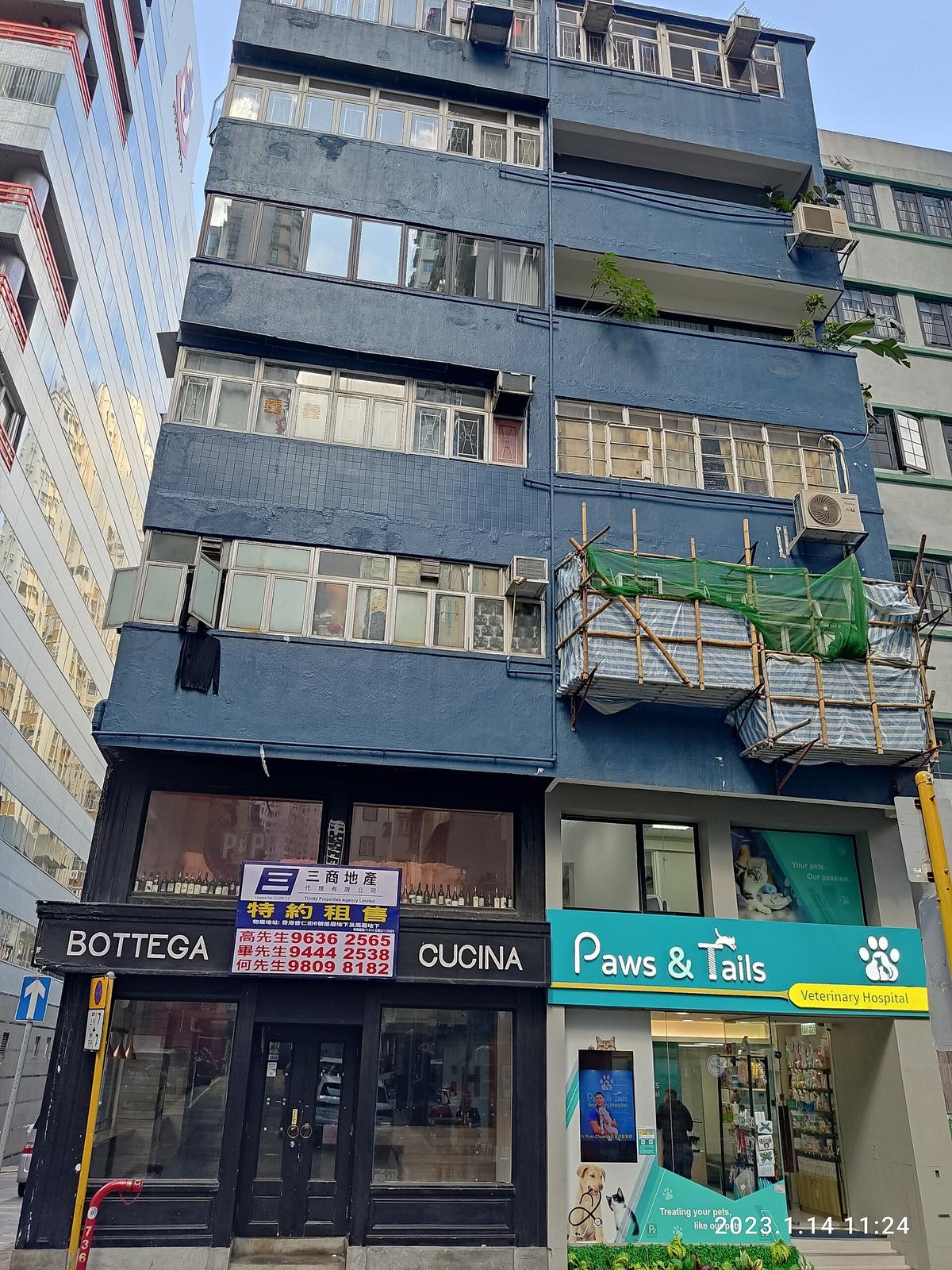
Sheung Wan has two distinct housing stocks. Walk-ups built between the 1950s and 1970s, limited to six storeys by the Building Regulations, dominate the PoHo area bounded by Tai Ping Shan Street, Square Street, Pound Lane and Upper Station Street. Modern towers from the 1990s to 2010s cluster near the Sheung Wan MTR exit.
The rent difference is substantial. A 500-square-foot tower flat near the MTR runs 25,000 to 35,000 HKD per month. The PoHo walk-up sits at 18,000 to 24,000. The tower gives you a lift, a lobby and windows that seal. The walk-up gives you the PoHo gradient, which on Tai Ping Shan Street rises at roughly one in six from Hollywood Road to Caine Road, and the walk-up gives you the smell.
The walk-up also gives you a better location for the Mid-Levels escalator. The westernmost entry point sits at the Connaught Road Central and Des Voeux Road Central junction. The Sheung Wan section runs along Jubilee Street, then doglegs westward via Queen's Road Central to Bonham Strand. From a PoHo flat you walk down the slope to catch the uphill phase between 10:20 and 00:00, or the downhill-only phase between 06:00 and 10:00. The escalator is free, runs daily and puts you at the top of Central in about 12 minutes of moving time.
What You Get for the Lower Rent
A PoHo flat in an older building rents for roughly 60 to 70 percent of the Central equivalent for the same net square footage. That saving is real and annual. What you lose is silence. What you lose is air that does not change with the direction of the harbour breeze. What you gain is a wet market at 345 Queen's Road Central open 06:00 to 20:00, a tram every two to four minutes on Des Voeux Road West during peak hours, and a 12-to-15-minute walk from the Queen Street junction to Statue Square in Central. The Sheung Wan MTR puts you at Central in two minutes and at Tsim Sha Tsui in six via Admiralty. The Airport Express at Kowloon is four minutes away by train after a short walk through Central.
The expat moving into Sheung Wan is a finance, legal or tech professional aged 28 to 40 on a first Hong Kong posting. The expat moving out has a child approaching school age and relocates to Mid-Levels, Pok Fu Lam or the Southside for school catchments. Predict your own tenure by whether the dried seafood smell is something you explain to visitors or something you stop noticing. If you stop noticing it within two months, you will stay. If you continue to register it every time you open the window, you will leave at lease renewal.
Which Flat to Choose
Take a tower unit near the Sheung Wan MTR if your budget runs to 25,000 to 35,000 HKD for 500 square feet. You lose the neighbourhood character. You gain weathertight windows and a lift that does not break in August. Take a walk-up in PoHo if you are willing to climb stairs, tolerate noise and accept that the building was built when Eisenhower was president. The saving is real. So is the maintenance: the walk-up stock is 1950s to 1970s construction and the plumbing will remind you of that fact.
Avoid any unit on Des Voeux Road West below the third floor on the street-facing side unless you work in the trade yourself. The Environmental Protection Department data from 2024 confirms what residents report: the smell on those floors is not occasional. It is structural. If you want the dried seafood neighbourhood without the dried seafood in your kitchen, take a flat on Upper Station Street or Pound Lane above the fourth floor. The topography and the prevailing wind spare those blocks most of the time.
Sheung Wan suits the renter who wants a fifteen-minute walk to Statue Square, lower rent per square foot than any comparable zone east of the MTR, and does not mind plain architecture and street noise. It does not suit anyone who works from home in an open-plan flat below the fourth floor on Des Voeux Road West. That specific configuration is a mistake you make once.

Common Questions
How far in advance should I start looking for a flat in Sheung Wan?
Start four to six weeks before your intended move-in date. Listings turn over quickly in the PoHo area, and the best tower units near the MTR exit come on the market with little notice. A shorter search window forces you into the units that have not rented because the smell is worse.
Can I avoid the dried seafood smell entirely in a Sheung Wan apartment?
Yes, if you take a flat above the third floor on a side street like Pound Lane or Upper Station Street, and not on the street-facing side of the block. Des Voeux Road West units below the third floor on the street side report persistent smell. That is a verified pattern, not a rumour.
What is the cheapest rent I can expect for a 500-square-foot flat in Sheung Wan?
A walk-up in PoHo at 18,000 to 24,000 HKD per month, based on 2025 market listings. That is the entry point. Anything below 18,000 means a subdivided unit, a higher floor with no lift or a building on Des Voeux Road West directly above the dried goods shops.
How long does it take to walk from PoHo to Central?
Fifteen to 18 minutes from Tai Ping Shan Street to Statue Square. From the Queen Street junction on Des Voeux Road West it is 12 to 15 minutes. The tram takes 8 to 10 minutes from Western Market. The MTR takes two minutes from Sheung Wan to Central.
Is the noise worse than the smell in Sheung Wan?
For most residents, yes. Des Voeux Road West registers 70 to 75 dB(A) during daytime hours according to the 2024 Environmental Protection Department monitoring. That is the noise level of a busy road with trams, buses and trucks. The smell is seasonal. The traffic noise is not.
When is the dried seafood smell strongest?
May through September, when heat and humidity intensify the odour from the open shopfronts. Peak trade volume runs October to February for Lunar New Year demand, but the cooler weather reduces how far the smell travels. Visit in August before you sign a lease.
Who typically moves out of Sheung Wan and why?
Families with children approaching school age. They relocate to Mid-Levels, Pok Fu Lam or the Southside for better school catchments. The median household income in Sheung Wan is 45,000 HKD per month from the 2021 Census, and the proportion of non-Cantonese speakers is 15 to 20 percent. Those numbers shift as the expat cohort ages out of the neighbourhood.
Read next
-

 Eating in Sheung Wan Old Trades New Cafes and Cha Chaan Tengs
A guide to eating in Sheung Wan that traces the line between the old dried-goods trade canteens and the new independent cafes on the same steep streets.
Eating in Sheung Wan Old Trades New Cafes and Cha Chaan Tengs
A guide to eating in Sheung Wan that traces the line between the old dried-goods trade canteens and the new independent cafes on the same steep streets.
-
 Hong Kong First Arrival Guide From Airport to Understanding the City
Hong Kong rewards those who treat it as a series of distinct neighbourhoods rather than a single city centre. Here is the geography and rhythm every newcomer needs.
Hong Kong First Arrival Guide From Airport to Understanding the City
Hong Kong rewards those who treat it as a series of distinct neighbourhoods rather than a single city centre. Here is the geography and rhythm every newcomer needs.
-
 Hong Kong Hotels and Serviced Apartments Before a Lease
Serviced apartments in Wan Chai, Kennedy Town, and Sai Ying Pun compared for the six weeks before you sign a Hong Kong lease.
Hong Kong Hotels and Serviced Apartments Before a Lease
Serviced apartments in Wan Chai, Kennedy Town, and Sai Ying Pun compared for the six weeks before you sign a Hong Kong lease.
-
 Where to Stay in Hong Kong a Shortlist of Districts Compared Honestly
Hong Kong districts vary wildly in rent, space, and commute reality. This shortlist compares where to stay based on what you actually get for your money.
Where to Stay in Hong Kong a Shortlist of Districts Compared Honestly
Hong Kong districts vary wildly in rent, space, and commute reality. This shortlist compares where to stay based on what you actually get for your money.
-
 Hong Kong Flights, HKG Airport and the Airport Express
HKG to Central or Kowloon by Airport Express, taxi, or A-bus, plus how Hong Kong's in-town check-in makes it a strong flight hub.
Hong Kong Flights, HKG Airport and the Airport Express
HKG to Central or Kowloon by Airport Express, taxi, or A-bus, plus how Hong Kong's in-town check-in makes it a strong flight hub.
-
 Central vs Sheung Wan Hong Kong One MTR Stop Apart and a Different Life
Central and Sheung Wan sit one MTR stop apart but offer two different Hong Kongs: one of glass finance and nightlife, the other of dried seafood, antiques, and slower streets.
Central vs Sheung Wan Hong Kong One MTR Stop Apart and a Different Life
Central and Sheung Wan sit one MTR stop apart but offer two different Hong Kongs: one of glass finance and nightlife, the other of dried seafood, antiques, and slower streets.
-
 Hong Kong Expat Cost of Living Broken Down by Lifestyle Tier
Real annual costs for expats in Hong Kong: budget, comfortable, and premium tiers covering rent by district, school fees, domestic helpers, and flights home.
Hong Kong Expat Cost of Living Broken Down by Lifestyle Tier
Real annual costs for expats in Hong Kong: budget, comfortable, and premium tiers covering rent by district, school fees, domestic helpers, and flights home.
-
 How to Set Up Your Finances When You First Arrive in Hong Kong
Open the right bank account, set up Octopus and FPS, and avoid costly transfer fees. A practical money setup guide for new arrivals in Hong Kong.
How to Set Up Your Finances When You First Arrive in Hong Kong
Open the right bank account, set up Octopus and FPS, and avoid costly transfer fees. A practical money setup guide for new arrivals in Hong Kong.
-
 Mobile Plans, SIM Cards and Connectivity Costs for Expats in Hong Kong
Compare 3HK, SmarTone, and CMHK mobile plans for Hong Kong expats. Monthly costs, data tiers, prepaid vs contract, and tips on staying connected abroad.
Mobile Plans, SIM Cards and Connectivity Costs for Expats in Hong Kong
Compare 3HK, SmarTone, and CMHK mobile plans for Hong Kong expats. Monthly costs, data tiers, prepaid vs contract, and tips on staying connected abroad.